 English
 français
 Deutsch
 Español
 italiano
 русский
 português
 العربية
 ไทย
ไทย čeština
 Polska
In 2026, wastewater treatment plants, municipal pump stations, drainage contractors, and industrial facilities are under sustained pressure to reduce unplanned downtime, emergency pump pull-outs, and maintenance labor costs. For ITT Flygt submersible pumps—one of the most widely deployed submersible pump platforms in global sewage and wastewater service—the flygt pump seal is the component most directly responsible for protecting the motor, bearings, and oil chamber from water ingress. When seal faces overheat, chip, run dry, or lose proper compression, the consequences escalate quickly: contaminated oil chambers, bearing failure, motor winding damage, and emergency retrieval from wet wells that costs multiples of the original seal replacement value.
Understanding the five most common flygt pump seal failure modes—and how to prevent them through correct selection, material upgrading, and installation practice—is the most cost-effective submersible pump maintenance strategy available in 2026. Sealcon manufactures replacement Flygt mechanical seals according to original materials and dimensions, covering old-structure, new-structure Griploc-style, cartridge, and plug-in type designs for multiple ITT Flygt pump series. The sections below address each failure cause and the corresponding solution.
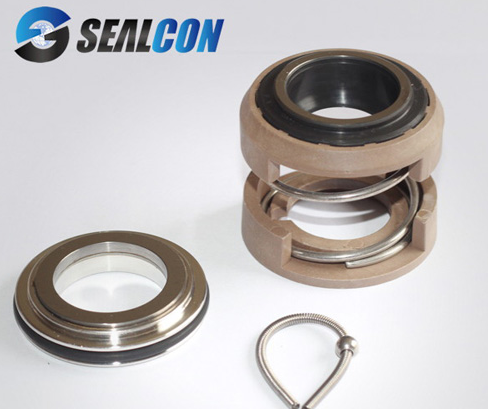
1. Dry Running and Oil Chamber Degradation: The Fastest Path to Seal Face Destruction
Dry running is the single most damaging operating condition for a submersible pump mechanical seal. A mechanical seal relies on a thin hydrodynamic film between the rotating and stationary faces to provide lubrication, cooling, and sealing. When the pump operates without sufficient liquid—or when the seal chamber oil has degraded, leaked, or been contaminated with water—this film breaks down and the faces run in direct contact.
The damage progression is rapid. Carbon faces can crack or spall within minutes of dry operation. Silicon carbide faces are more resistant but will develop thermal stress fractures under sustained dry running. Once a face is cracked or chipped, the seal cannot maintain a flat contact surface, and leakage becomes immediate and progressive.
Common symptoms of dry running damage:
Burn marks, discoloration, or thermal cracking on seal faces
Carbon face fragmentation or spalling
Sudden leakage after a short operating period following maintenance
Elevated motor temperature or thermal protection trips
Oil chamber contamination with water or emulsified fluid
Prevention and correction:
Verify liquid level controls, float switches, and low-level protection before commissioning or returning a pump to service
Avoid frequent short-cycling, which prevents adequate liquid from reaching the seal area between starts
Inspect seal chamber oil condition at every scheduled maintenance interval—milky or water-contaminated oil indicates seal compromise
For applications with intermittent flow or variable wet well levels, consider upgrading to SiC/SiC or TC/TC face combinations, which provide greater thermal shock resistance than carbon/ceramic pairs
2. Installation Errors and Plug-In Seal Misalignment: Why Correct Assembly Technique Matters
Flygt's plug-in and cartridge-style seal designs are a significant maintenance advantage—they allow faster replacement without special tooling and protect sensitive sealing surfaces during handling. However, this design also means that installation accuracy is critical. An unevenly seated plug-in seal, a contaminated O-ring groove, or an incorrectly matched upper/lower seal position will produce leakage that appears to be a seal quality problem but is actually an installation problem.
ITT Flygt pumps typically use two independent seals: a lower seal exposed directly to the pumped medium (which must withstand abrasive particles, fibrous material, chemical aggression, and hydraulic pressure) and an upper seal operating in a cleaner buffer fluid environment protecting the motor housing. These two seals have different design requirements and are not interchangeable. Sealcon's Flygt replacement seal range covers both positions, with model codes that distinguish upper (U suffix) and lower (L suffix) seal positions across the product series.
Common installation failure symptoms:
Leakage immediately after installation or within the first few operating hours
Uneven or one-sided wear pattern on the seal face after short service
O-ring pinching, deformation, or extrusion visible on disassembly
Cracked or chipped seat ring from uneven seating pressure
Seal face chipping during initial startup
Prevention and correction:
Always confirm the exact Flygt pump model and whether the seal is for the upper or lower position before ordering
Clean all seal chamber surfaces, O-ring grooves, and shaft surfaces thoroughly before installation
Apply only approved, compatible lubricant to O-rings—never use petroleum-based grease on EPDM elastomers
Seat plug-in seals with even, controlled pressure; never use a hammer directly on the seal face or seat
Replace upper and lower seals as a matched set when the pump design requires it, rather than replacing only the failed component
3. Abrasive Media Sealing: How Particles Destroy Standard Seal Faces
Municipal sewage, construction drainage, industrial wastewater, and sludge handling applications expose the lower seal of a Flygt submersible pump to some of the most demanding conditions in rotating equipment service. Sand, grit, fibrous solids, silt, and process residues can enter the seal area, score the face surfaces, damage elastomers, and accelerate leakage to the point where seal life is measured in weeks rather than years.
The abrasive damage mechanism operates on two levels. Hard particles that enter the seal face interface act as a lapping compound, progressively removing material from both the rotating and stationary faces. Simultaneously, particles that accumulate in the elastomer area can prevent the bellows or O-ring from maintaining proper compression, reducing the sealing force and allowing fluid bypass.
Standard carbon/ceramic face combinations, while cost-effective for clean water service, are not adequate for sustained abrasive media exposure. The carbon face is relatively soft and will wear rapidly when hard particles are present. Ceramic seats, while harder, can fracture under impact from larger particles.
Material upgrade options for abrasive media sealing:
| Media Condition | Recommended Face Combination |
|---|---|
| Clean water, low solids | Carbon / Ceramic |
| Moderate solids, municipal sewage | Carbon / SiC or SiC / SiC |
| High grit, sand, abrasive slurry | SiC / SiC or TC / TC |
| Impact risk, fibrous solids | TC / TC |
For elastomer selection in chemically aggressive wastewater, FKM/Viton provides broader chemical resistance than NBR, while EPDM is suitable for applications involving oxidizing agents or steam-cleaned systems. Stainless steel metal parts (SS316) are recommended for corrosive wastewater environments.
Sealcon's Flygt replacement seal range covers multiple model series with material upgrade options, allowing maintenance buyers to specify the appropriate face and elastomer combination for the actual operating environment rather than defaulting to the original standard specification.
4. Wrong Seal Model and Upper/Lower Position Confusion: The Selection Errors That Cause Premature Failure
Flygt pump seal selection is more complex than selecting by shaft diameter alone. The pump model, seal code, upper or lower position, structural generation (old-structure vs. new-structure Griploc vs. plug-in cartridge), and material combination all affect whether the replacement seal will perform correctly in service.
Sealcon lists multiple Flygt replacement seal model series including FAL/FAU, FBL/FBU, FEL/FEU, FKL/FKU, FML/FMU, FOL/FOU, and others, each corresponding to specific Flygt pump series and seal positions. Selecting by shaft size alone—without confirming the pump model and seal code—is one of the most common procurement errors in Flygt seal replacement, and it produces either immediate installation failure or significantly shortened service life.
Common selection mistakes and their consequences:
Confusing upper and lower seal: the lower seal is designed for direct media exposure with hard faces (tungsten carbide is the standard for the lower position in harsh service); the upper seal operates in cleaner buffer fluid and can use softer, less expensive face materials. Installing an upper seal in the lower position will result in rapid abrasive wear.
Selecting old-structure components for a new-structure pump: Griploc-style seals use a patented locking mechanism that differs from older designs; mixing components from different structural generations prevents correct assembly.
Reusing worn seats or O-rings with a new seal face: a worn or scratched seat will immediately damage the new face surface; all mating components should be replaced together.
Correct selection checklist:
Exact Flygt pump model number
Seal code from the pump nameplate or maintenance record
Upper or lower seal position
Shaft diameter
Structural type: old-structure, Griploc/new-structure, or plug-in cartridge
Pumped media and abrasive content
Required elastomer material
Quantity and whether a complete upper/lower set is needed
5. Shaft Wear, Vibration, and Bearing Problems: When the Seal Is Not the Root Cause
A high-quality replacement seal installed in a pump with worn bearings, shaft runout, or mechanical vibration will fail prematurely—and the failure will be attributed to the seal rather than the underlying mechanical condition. This is one of the most common sources of repeated seal failure in submersible pump maintenance programs, and it is also one of the most preventable.
The mechanical logic is straightforward. A mechanical seal maintains its sealing function by keeping the rotating and stationary faces in flat, even contact under controlled load. Shaft runout—radial deviation of the shaft during rotation—creates a cyclic loading variation on the seal faces that causes uneven wear, face chipping, and eventual leakage. Worn bearings amplify shaft runout and introduce axial movement that exceeds the seal's compensation range. Cavitation and hydraulic overload create pressure pulsations that further destabilize the seal face contact.
Common symptoms of mechanical root cause:
Repeated seal failure after short runtime following replacement
Uneven or crescent-shaped wear pattern on one side of the seal face
Audible bearing noise or elevated bearing temperature
Visible grooves or fretting on the shaft sleeve
Oil chamber contamination recurring shortly after oil change
Vibration detectable during operation
Correct diagnostic and repair sequence:
Before installing a replacement seal, inspect bearing condition—replace if there is any play, noise, or heat
Check shaft runout with a dial indicator; confirm it is within the seal manufacturer's tolerance
Inspect the shaft sleeve for grooves, fretting, or corrosion; replace if damaged
Verify the pump operating point against the performance curve—operation far from the best efficiency point increases radial loads and vibration
Check wear rings and impeller clearance; excessive wear increases hydraulic imbalance
Addressing the mechanical root cause before seal replacement is the only way to break the cycle of repeated premature seal failure.
Selection Guide, Maintenance Workflow, and TCO Logic
Complete Selection Workflow for Troubleshooting ITT Flygt Seal Problems
Identify the exact pump model from the nameplate—not from a similar pump in the same station
Confirm upper or lower seal position and whether a complete set replacement is required
Record the existing seal code and structural type (old-structure, Griploc, plug-in cartridge)
Define the pumped media: clean water, municipal sewage, grit-laden wastewater, industrial effluent, sludge, or chemical wastewater
Select face and elastomer materials matched to the abrasion level, chemical content, and temperature
Inspect mechanical condition before ordering—bearings, shaft sleeve, wear rings—to confirm the seal is the root cause
Order as a complete maintenance kit including seal, seat, O-rings, and any related gaskets to avoid partial replacement failures
Maintenance and TCO Advantages
Fewer emergency pump pull-outs are the primary TCO driver. An emergency retrieval from a wet well—including crane or lifting equipment, confined space entry procedures, bypass pumping, and emergency labor—can cost 10–50 times the value of the seal that failed. Correct seal selection and proactive replacement on a scheduled basis eliminates most of these events.
Longer motor and bearing life from effective sealing. Water ingress through a failed seal contaminates the oil chamber, accelerates bearing corrosion, and can reach motor windings. A single water ingress event can write off a pump that would otherwise have years of remaining service life.
Lower maintenance labor from plug-in and cartridge-style seal designs. Sealcon's Flygt replacement seals in plug-in format allow faster replacement without special tooling, reducing the skilled labor time required per maintenance event and supporting faster pump turnaround.
Better spare parts planning from a supplier that covers multiple Flygt pump series with stocked replacement seals. Sealcon states that its Flygt seal series is complete, available from stock, with 3–5 day fast delivery at approximately one-third of the original OEM price—a procurement advantage for maintenance teams managing multiple pump models across a station or fleet.
Conclusion
Most flygt pump seal failure follows a predictable pattern: dry running damage, installation error, abrasive media wear, wrong model selection, or unaddressed mechanical problems in the pump. In 2026, the most cost-effective submersible pump maintenance strategy combines systematic troubleshooting ITT Flygt failure modes with a reliable replacement seal supplier that can match pump models, seal structures, and material upgrades for harsh wastewater and sewage service. Sealcon supplies replacement Flygt mechanical seals for multiple ITT Flygt pump series—including plug-in and cartridge designs—with material upgrade options for abrasive media sealing and fast delivery from stock.
Visit the Sealcon Flygt Mechanical Seals page to request a recommended seal configuration and quotation.
Please submit the following details for an accurate recommendation:
Work condition: Wastewater, sewage, slurry, clean water, chemical wastewater, operating temperature, solids content, abrasive level
Quantity: Sample order, maintenance stock quantity, or annual demand
Size/spec: ITT Flygt pump model, seal code, upper or lower seal position, shaft diameter, existing material combination, structural type (old/new/plug-in)
Target metrics: Longer seal life, reduced leakage, lower downtime, easier installation, abrasive resistance improvement
Current problems: Dry running damage, repeated leakage after replacement, abrasive wear, installation failure, shaft wear, bearing failure, water ingress into motor
FAQ
1. What is an ITT Flygt pump seal?
A mechanical seal designed specifically for ITT Flygt submersible pumps and mixers, available in old-structure, new-structure Griploc-style, and plug-in cartridge configurations. Flygt pumps use two independent seals—upper and lower—with different design requirements and material specifications for each position.
2. Flygt replacement seal vs. universal mechanical seal: which is better?
A model-matched Flygt replacement seal is the correct choice for Flygt pumps. Universal seals may not match the plug-in geometry, upper/lower position requirements, or seat dimensions of specific Flygt pump models, leading to installation problems or shortened service life. Sealcon manufactures Flygt replacement seals to original dimensions and materials for direct compatibility.
3. What is the ROI of upgrading Flygt pump seals?
ROI comes primarily from avoiding emergency pump pull-outs, preventing water ingress damage to bearings and motor windings, reducing maintenance labor through plug-in installation, and extending the interval between seal replacement events through material upgrades matched to the actual operating condition.
4. Do Flygt plug-in seals require pump modification?
No. Plug-in and cartridge-style replacement seals are designed for direct installation without special tooling or pump modification. Buyers must confirm the pump model, seal code, upper or lower position, and structural type before ordering to ensure dimensional compatibility.
5. What parameters are needed for correct Flygt seal selection?
ITT Flygt pump model number, seal code, upper or lower seal position, shaft diameter, structural type (old-structure/Griploc/plug-in), pumped media and solids content, operating temperature, current failure symptom, and any material upgrade requirement such as SiC/SiC, TC/TC, FKM, EPDM, or SS316 hardware.
-
China Water Pump Spare Parts: Complete Guide to Water Pump Components and Parts List
-
Different Types of Pump Seals: A Complete Guide to Pump Mechanical Seal Types
-
Mechanical Seal Stationary Seat: Complete Guide to Stationary Parts Sealing and Seal Seat Selection
-
Flygt Pump Mechanical Seal Installation Guide: Choosing Compatible Replacement Seals for Flygt Pumps
-
Sealing Sense
-
Classification Of Rubber Seal Ring